How to Build an Active Calendar (A Simple 12-Week Plan)
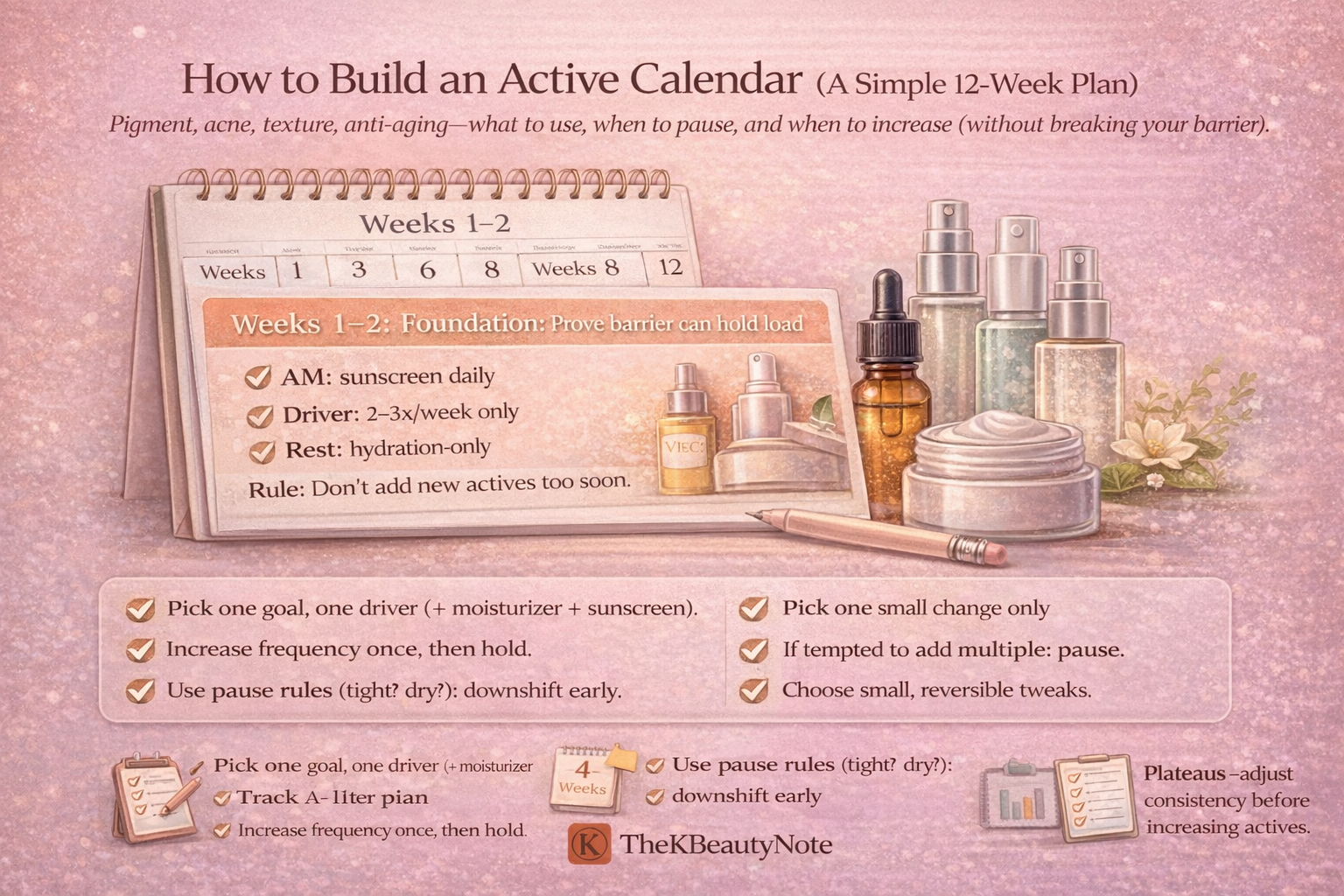
Pigment, acne, texture, anti-aging—what to use, when to pause, and when to increase (without breaking your barrier).
Most routines fail for one reason:
they don’t have a timeline.
You start strong, feel dry, pull back, restart, change products, then repeat.
An active calendar solves that.
It turns “random skincare” into a plan your barrier can actually tolerate.
This post gives you a simple 12-week structure you can repeat—without increasing barrier load.
You’ll learn:
- how to build a 12-week plan around one main goal
- how to choose a driver + a support (without stacking)
- exactly when to increase frequency (and when not to)
- what to do if you plateau or start to sting
Start with the rule: calendars work because they control load
Actives don’t only work because they’re powerful.
They work because they’re consistent.
A calendar keeps you consistent without escalating too fast—which is how most flare-ups happen.
Your hydration system still runs the routine:
- bind water
- reduce water loss (TEWL)
- support barrier lipids
Actives add load.
A calendar keeps that load predictable.
Step 1) Pick one goal (don’t combine goals in Week 1)
Choose one primary goal for the next 12 weeks:
- Pigment / dullness
- Acne / congestion
- Texture
- Anti-aging
You can still get secondary benefits, but your plan needs one “driver.”
Step 2) Choose one driver + one support
This is the simplest structure that works.
Driver = the active that moves the goal
Examples:
- Pigment: Vitamin C (AM) or retinoid (PM)
- Acne: retinoid (PM) or BHA (PM)
- Texture: retinoid (PM) or gentle exfoliant (PM)
- Anti-aging: retinoid (PM)
Support = the thing that keeps the barrier quiet
Most of the time this is not another serum.
Support usually means:
- a consistent barrier-support moisturizer
- gentler cleansing
- fewer steps
- strategic sealing (occlusive only when needed)
If you add too many “supports,” your routine becomes harder to control.
Keep it simple.
Step 3) Set your baseline: Stable Mode check (before Week 1)
You’re ready to start if (last 3 days):
- cleansing doesn’t leave lingering tightness
- moisturizer doesn’t sting
- redness isn’t persistent
- texture isn’t suddenly rough
- you’re not reacting to products you normally tolerate
If you’re not stable, start with a short reset:
- hydration-only routine for 3–7 days
- then begin Week 1
The 12-Week Active Calendar (simple and repeatable)
Weeks 1–2: Foundation (prove your barrier can hold the plan)
Goal: consistency, not speed.
- AM: sunscreen daily
- Driver:
- Vitamin C → 2–3 mornings/week
- Retinoid → 2 nights/week
- BHA/exfoliant → once weekly (only if it’s your driver)
- All other nights: hydration-only
- Support: barrier-support moisturizer every night
Rule: don’t add a second active category during Weeks 1–2.
If you sting repeatedly here, you’re not failing—your timeline is too fast.
Weeks 3–4: Build (increase frequency once—then hold)
Goal: add load slowly.
Increase your driver by one step:
- Vitamin C → every other morning
- Retinoid → 3 nights/week
- BHA (as driver) → 2 nights/week (only if stable)
Hold the rest steady.
This is where most people make the mistake:
they increase frequency and add a new active at the same time.
Don’t.
Weeks 5–8: Momentum (maintain, then adjust only if calm)
Goal: steady progress without flare-ups.
If your skin is stable:
- Vitamin C → most mornings
- Retinoid → every other night only if comfortable
- Exfoliant (if not the driver) → keep at once weekly max
If your skin is “quiet but dry”:
- don’t reduce moisturizer
- reduce exfoliation first
- keep retinoid schedule steady (don’t increase)
The winning move in Weeks 5–8 is holding.
Most results come from consistency here.
Weeks 9–12: Optimize (small improvements, minimal risk)
Goal: fine-tune without increasing barrier load.
Pick only one optimization:
- add one more retinoid night or
- add one more Vitamin C morning or
- add one gentle exfoliation night (if texture needs it)
If you’re tempted to add multiple changes:
that’s not optimization—that’s stacking.
Goal-based calendars (choose your track)
Track A: Pigment / dullness (barrier-safe brightening)
Driver: Vitamin C (AM)
Optional later driver: retinoid (PM) only after Week 4 if stable
Simple plan
- Weeks 1–2: Vitamin C 2–3 mornings/week
- Weeks 3–4: every other morning
- Weeks 5–12: most mornings if comfortable
- Optional (after Week 4): retinoid 2 nights/week, held steady
Pigment improves when you avoid irritation.
Irritation often makes pigment look worse.
Track B: Acne / congestion (stabilize first, then drive)
Choose one driver:
- retinoid (PM) for comedones + long-term control
- BHA (PM) for congestion (especially if oily)
Retinoid driver plan
- Weeks 1–2: 2 nights/week
- Weeks 3–4: 3 nights/week
- Weeks 5–12: every other night only if stable
- Exfoliant: optional, once weekly max
BHA driver plan
- Weeks 1–2: once weekly
- Weeks 3–4: twice weekly
- Weeks 5–12: hold at 2 nights/week
- Retinoid (optional): 1–2 nights/week only after Week 4
Acne routines fail when they become aggressive routines.
Keep load controlled.
Track C: Texture (smoothness without over-exfoliating)
Driver: retinoid (PM)
Optional support: one gentle exfoliation night weekly
Plan:
- Weeks 1–2: retinoid 2 nights/week
- Weeks 3–4: 3 nights/week
- Weeks 5–12: hold at 3 nights/week (or every other night only if stable)
- Exfoliant: once weekly max, never same night as retinoid
Texture improves when your barrier stays calm enough to keep going.
Track D: Anti-aging (the long game)
Driver: retinoid (PM)
Support: barrier-support moisturizer, sunscreen daily
Plan:
- Weeks 1–2: 2 nights/week
- Weeks 3–4: 3 nights/week
- Weeks 5–12: every other night only if stable
- Vitamin C: optional in AM if it doesn’t sting
Anti-aging is the easiest goal to sabotage with impatience.
Your pause rules (what to do when your skin starts warning you)
A calendar needs a pause protocol.
Level 1: Caution
- mild tightness
- small dry patches
Action: - don’t increase
- add barrier support at night
- spot-occlusive where needed
Level 2: Warning
- repeated stinging
- lingering redness
- rough/sandpapery texture
Action: - pause actives 3–7 days
- run the 72-hour reset
- restart at last stable frequency
Level 3: Stop
- burning/itching/cracking/weeping
Action: - stop actives
- keep routine minimal
- consider professional evaluation if severe or persistent
The plateau rule (when results stop moving)
Plateaus don’t always mean “add more.”
Ask first:
- did my barrier get noisier? (then reduce load)
- did my schedule become inconsistent? (then simplify)
- did I change climate/lifestyle? (then adjust load)
If you’re stable and consistent for 4+ weeks:
- increase only one variable
- then hold again
Quick takeaways
- A 12-week calendar works because it keeps routine load predictable.
- Pick one goal, choose one driver, and keep barrier support stronger during ramp-up.
- Increase frequency once, then hold. Consistency beats intensity.
- Use pause rules early—before a flare-up forces a full reset.
- Plateaus are often solved by better consistency, not stronger actives.
Related posts in this Skin Functions series
- Skin Barrier & TEWL
- Hydration as a System
- Hydration Product Types: Humectants, Occlusives, and Barrier Support
- Hydration Routine by Season and Humidity
- Build a Hydration Routine That Matches Your Skin
- How to Introduce Actives Without Breaking Your Hydration System
- How to Choose Actives by Skin Goal (Without Increasing Barrier Load)
- How to Combine Actives Safely in Real Life
- How to Patch-Test and Troubleshoot Reactions
- How to Use Actives by Season and Lifestyle
- How to Use Actives by Skin Type (Without Changing the Active)
Next in Skin Functions
Next post: How to choose product formats (serum, toner, cream) and layer them correctly—so you get results without piling on steps.