
Hydration as a System
Water binding, water loss reduction, and barrier lipid support
People often talk about “hydration” as if it is one thing: applying a hydrating toner, drinking more water, or using a thicker cream.
But in skin biology, hydration behaves more like a system. It depends on three functions working together:
- Water binding (holding water inside the outer skin)
- Water loss reduction (slowing TEWL)
- Barrier lipid support (keeping the barrier structure organized)
When these pieces are balanced, skin tends to feel comfortable, flexible, and less reactive. When one piece is missing, skin may still feel dry or tight even if you are using “hydrating” products.
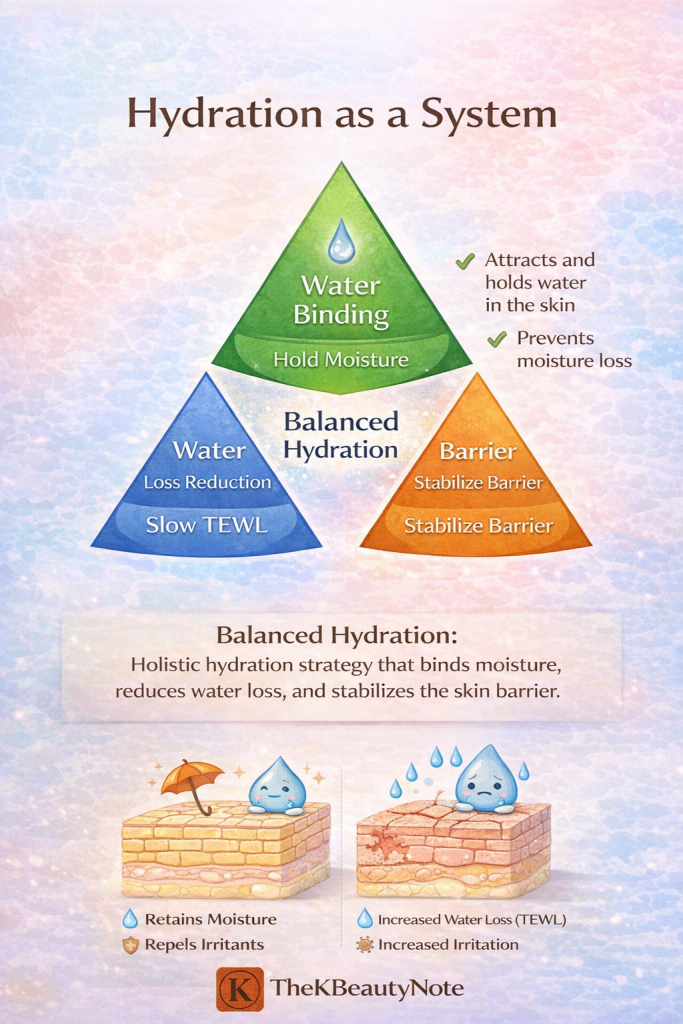
Hydration works as a 3-part system: bind water, slow water loss (TEWL), and support barrier lipids.
1) Water binding: keeping water where it belongs
The outermost layer of the skin (the stratum corneum) needs water to stay smooth and functional. Water binding is the process of holding water within that layer so it does not evaporate too quickly.
In practice, water binding support usually comes from humectants—ingredients that attract and hold water.
Common examples include:
- Glycerin
- Hyaluronic acid
- Betaine
- Panthenol
- Sodium PCA and other NMF-related components
A useful way to think about humectants: they can increase the skin’s water content, but they do not automatically prevent water from escaping. That is why some people feel temporarily plump and then quickly dry again if the rest of the system is weak.
2) Water loss reduction: lowering TEWL without sealing the skin
TEWL (transepidermal water loss) is normal, but it rises when the barrier is strained. When TEWL is higher, skin can feel tight, rough, or irritated even if you apply plenty of watery layers.
Water loss reduction is mostly about slowing evaporation.
This can be supported by:
- Occlusive or semi-occlusive layers that reduce evaporation
- Reducing routine stress (over-cleansing, frequent exfoliation, too many strong actives)
- Adapting to low-humidity environments (winter, indoor heating, travel)
This does not mean you need a heavy ointment every day. It means the routine should include some strategy that prevents water from leaving faster than you can replace it.
3) Barrier lipid support: the structure that makes hydration last
In the barrier model, the stratum corneum is often described as bricks and mortar:
- “Bricks” = corneocytes
- “Mortar” = a lipid matrix made largely of ceramides, cholesterol, and fatty acids
Hydration lasts longer when this lipid “mortar” is organized. When the lipid structure is disrupted, water escapes more easily and skin becomes more sensitive to everyday exposures.
Barrier lipid support can come from:
- Barrier-supportive moisturizers (often containing ceramides and lipid-like ingredients)
- Gentle routines that allow the skin to rebuild stability
- Consistency over intensity (especially after irritation)
This is why Korean skincare often emphasizes hydration and barrier care before corrective steps. It is not a trend—it is a practical way to keep the hydration system stable over time.
Putting it together: why “hydration” sometimes doesn’t work
If hydration is a system, then one missing piece can explain many common frustrations:
- Humectants only (water binding), no protection: skin feels good briefly, then dries again
- Occlusion only (water loss reduction), no water binding: skin feels coated but still not comfortable
- Lipids ignored (weak barrier support): hydration never lasts, and sensitivity stays high
A well-built routine usually does not rely on one hero step. It stacks small supports across the system.
Quick routine check
If your skin feels dehydrated, ask:
- Do I have water binding in my routine (humectants)?
- Do I have water loss reduction (a moisturizer step that slows evaporation)?
- Do I support barrier lipids (gentle routine + barrier-supportive formula)?
If two or more are missing, the simplest upgrade is not “more products.”
It is adding the missing function and lowering routine stress for one to two weeks.
Next in Skin Functions
Next post breaks down product types in plain terms, including humectants, occlusives, and barrier-supporting ingredients, so you can build a routine that matches your skin.