How to Introduce Actives Without Breaking Your Hydration System
Vitamin C, retinoids, exfoliants—and how to catch barrier stress early (before a flare-up).
Actives are powerful.
But they don’t work in a vacuum.
They work on skin that is already doing three jobs every day:
- Bind water (hold it inside the upper layers)
- Reduce water loss (slow TEWL)
- Support barrier lipids (keep the barrier resilient)
That’s your hydration system.
Actives add “load” to that system.
If the load is too high too fast, the barrier gets noisy: stinging, tightness, redness, rough texture—then you stop everything.
This post is about preventing that cycle.
You’ll learn:
- how to introduce actives without collapsing your hydration system
- how to spot early barrier stress before it becomes a flare-up
- what to do the moment your skin starts warning you
Actives don’t “replace” hydration. They test it.
Vitamin C, retinoids, exfoliants can improve tone, texture, acne, and aging.
But they can also make your skin more likely to:
- lose water faster (TEWL often rises when the barrier is stressed)
- feel reactive to products that were “fine yesterday”
- become dry and oily at the same time (classic dehydration pattern)
So the goal isn’t “use actives” or “avoid actives.”
The goal is this:
Introduce actives only when your hydration system is stable—then keep water-loss reduction and barrier support stronger than usual while you ramp up.
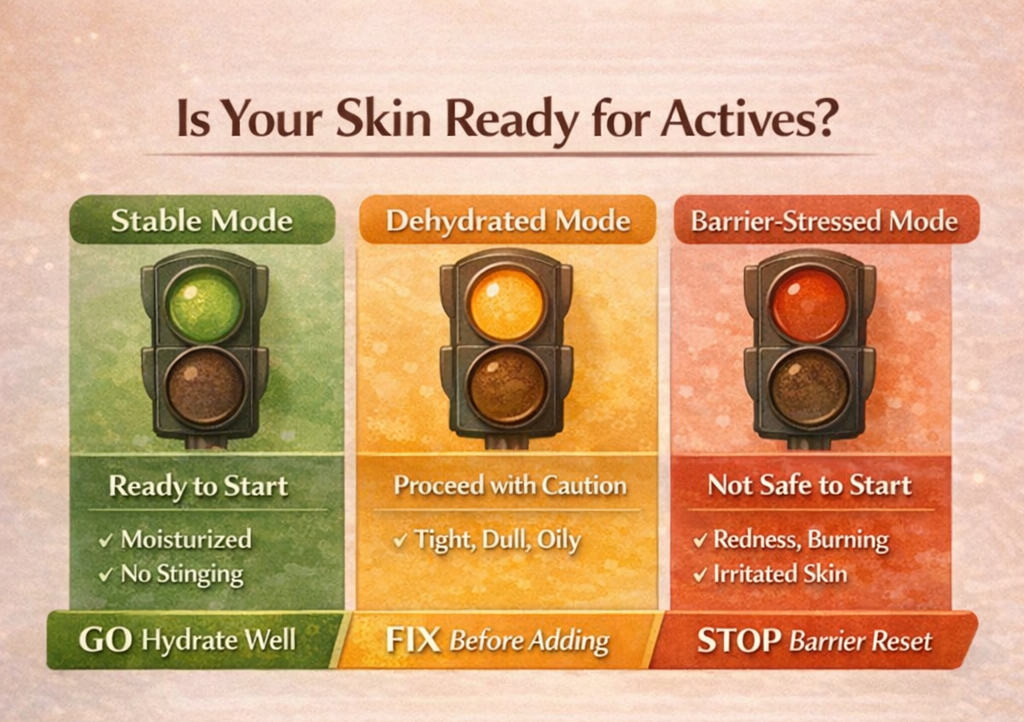
Step 1) Confirm you’re in Stable Mode
Before adding any active, run a quick check.
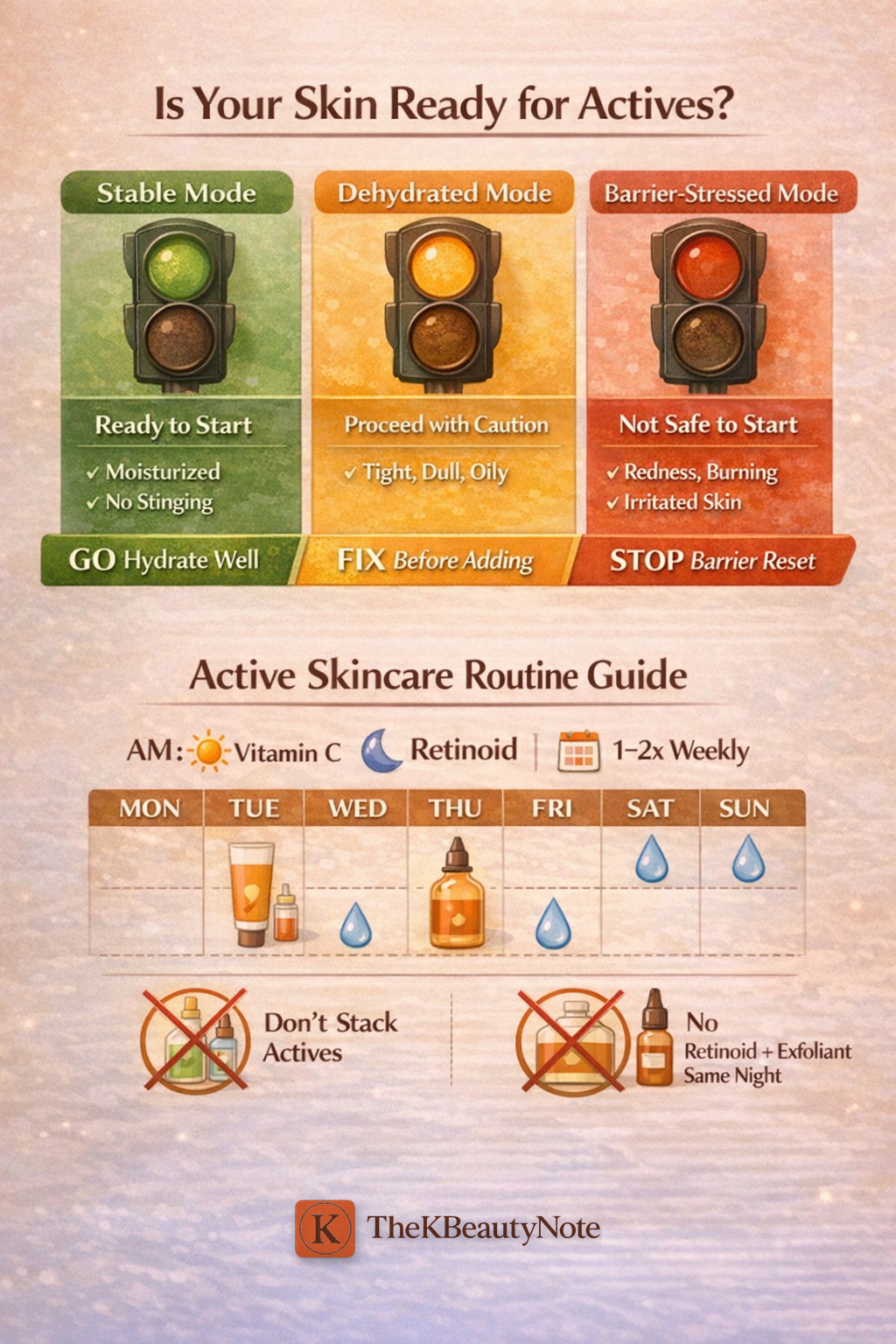
You’re likely stable if (last 3 days):
- Cleansing doesn’t leave lingering tightness
- Your moisturizer doesn’t sting
- You don’t have persistent redness or burning
- Texture isn’t suddenly rough or sandpapery
- You aren’t reacting to products you normally tolerate
If you’re not stable, don’t “push through.”
Do one of these instead:
- Dehydrated mode → rebuild hydration layers (bind + seal)
- Barrier-stressed mode → reset first (see the 72-hour reset below)
Actives are easiest when the skin is calm.
Step 2) The three rules that prevent flare-ups
This is the part most routines skip.
Rule #1: One active at a time
Introduce one active. Stabilize. Then add the next.
If you start vitamin C + retinoid + exfoliant together, you won’t know what caused the problem.
Simple standard: give each new active 2–4 weeks before adding another.
Rule #2: Frequency before strength
Most irritation isn’t from “the ingredient.”
It’s from “too often too soon.”
Start with low frequency.
Increase slowly.
Rule #3: Over-support during ramp-up
During the first few weeks, assume your barrier needs extra help.
That means:
- gentler cleansing
- fewer steps
- more consistent barrier-support moisturizer
- occlusive only when you actually need sealing
Actives don’t need a complicated routine.
They need a stable one.
Step 3) Where actives fit in your hydration layering
Your layering doesn’t change.
Actives simply take a slot inside it.
The simple map
Cleanse → (optional hydrating layer) → Active → Barrier-support moisturizer → (optional occlusive)
- Hydrating layer: if your skin likes it
- Barrier-support moisturizer: non-negotiable during ramp-up
- Occlusive: optional, best used strategically (thin layer or spot-apply)
Step 4) How to introduce each active (simple schedules)
You don’t need perfection.
You need a plan you can actually keep.
A) Vitamin C (AM)
Vitamin C is usually easiest in the morning—but it can sting if your barrier is shaky.
Start here:
- Weeks 1–2: 2–3 mornings/week
- Weeks 3–4: every other morning
- Week 5+: most mornings if comfortable
Placement (AM):
Cleanse → (optional hydrating layer) → Vitamin C → moisturizer → sunscreen
If you feel stinging:
One mild sting once isn’t always a disaster.
But repeated stinging is a signal. Treat repetition as the warning.
B) Retinoids (PM)
Retinoids are the most common way people accidentally break their hydration system—because they ramp too fast.
Start here:
- Weeks 1–2: 2 nights/week (ex: Mon/Thu)
- Weeks 3–4: 3 nights/week
- Weeks 5–6: every other night
- Beyond: only increase if your skin stays stable
Two simple safety moves (especially early):
- Apply to completely dry skin (wait 10–20 minutes after cleansing)
- Use buffering (it’s not cheating):
Cleanse → moisturizer → retinoid → moisturizer
This keeps your barrier quieter while your skin adapts.
C) Exfoliants (PM, weekly)
Exfoliants help.
But over-exfoliation is one of the fastest routes to barrier stress.
Start here:
- Weeks 1–2: once weekly
- Weeks 3–4: up to twice weekly only if needed
Exfoliation night = simplify night
Cleanse → (optional hydrating layer) → exfoliant → barrier-support moisturizer → (optional occlusive)
Don’t chase tingling.
Tingling is not a scoreboard.
Step 5) Don’t stack “high-load nights”
If you want a rule that prevents 80% of problems, it’s this:
Don’t use a strong exfoliant on the same night as a retinoid.
Think: leave-on acids, stronger acids, or high-frequency exfoliation.
When people “react to retinoids,” they’re often reacting to the total load from multiple stressors.
Keep your schedule clean.
A conservative weekly map (example)
- Mon PM: Retinoid
- Tue PM: Hydration-only
- Wed PM: Exfoliant
- Thu PM: Hydration-only
- Fri PM: Retinoid
- Sat PM: Hydration-only
- Sun PM: Hydration-only
This looks slow.
Slow is what keeps you consistent.
Step 6) Early signs of barrier stress (catch it before it flares)
A flare-up rarely starts overnight.
Most of the time, your skin gives early signals.
Level 1: Caution
Signs
- mild tightness after cleansing
- small dry patches
- slight sensitivity that fades quickly
Action
- keep the active the same (don’t increase)
- add more barrier support at night
- use spot occlusive on dry areas if needed
Level 2: Warning
Signs
- products start stinging repeatedly
- redness lingers longer than usual
- texture becomes rough/sandpapery
- you feel dry and oily at the same time (dehydration pattern)
Action
- pause actives 3–7 days
- run a reset
- reintroduce one active only after stinging is gone
Level 3: Stop
Signs
- burning, persistent itch, cracking, or weeping
- irritation that escalates day by day
Action
- stop actives
- keep the routine minimal and gentle
- if intense or persistent, consider professional evaluation
The 72-hour Barrier Reset (the moment you notice warning signs)
This is your “exit ramp.”
For the next 72 hours:
- Gentle cleanse (or rinse only in the morning if you can)
- Barrier-support moisturizer (AM + PM)
- Optional occlusive at night (thin layer or spot-apply)
- Sunscreen in the morning
- No actives (pause vitamin C, retinoids, exfoliants)
After 72 hours:
- If stinging/redness are gone → reintroduce one active at lower frequency
- If not → extend reset and keep it simple
Small rules that protect your progress
These sound minor. They’re not.
- Don’t change your cleanser the same week you start a new active
- Don’t introduce multiple new serums at once
- Don’t ramp up during dry weather, travel, illness, or stress
- If something works, change one variable at a time
Consistency beats intensity—especially with actives.
Quick takeaways
- Actives add load. Hydration systems fail when water-loss reduction and barrier support can’t keep up.
- Start only in Stable Mode.
- Use one active at a time, build frequency before strength, and over-support your barrier during ramp-up.
- Learn the early warning signs and use the 72-hour reset before a flare-up starts.
Related posts in this Skin Functions series
- Skin Barrier & TEWL
- Hydration as a System
- Hydration Product Types: Humectants, Occlusives, and Barrier Support
- Hydration Routine by Season and Humidity
- Build a Hydration Routine That Matches Your Skin
Next in Skin Functions
Next post: How to choose actives by skin goal (pigment, acne, texture, anti-aging) without increasing barrier load—and how to troubleshoot when results plateau.