Build a Hydration Routine That Matches Your Skin
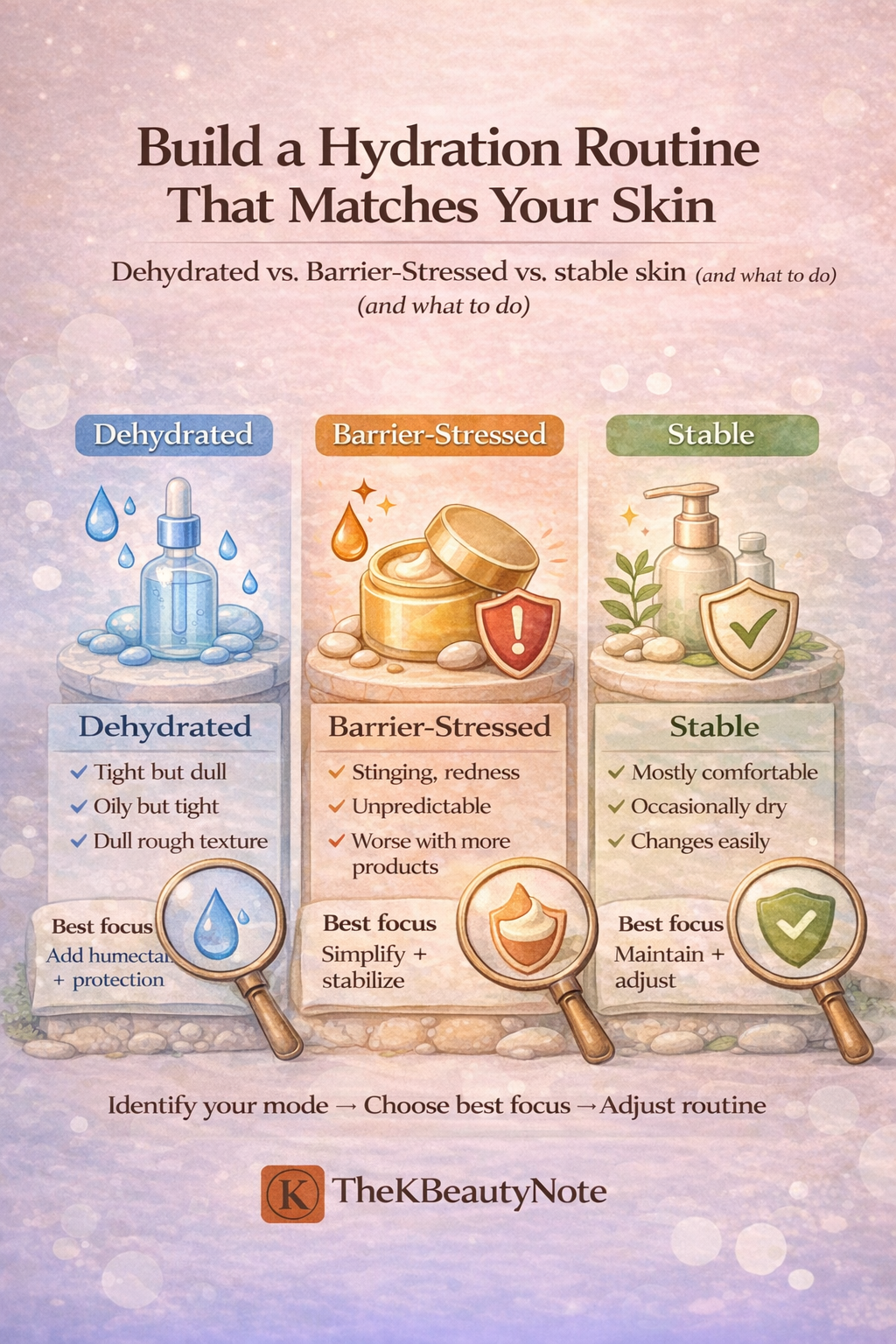
A lot of “hydration confusion” comes from one mistake: treating every dry feeling as the same problem.
But skin can feel dry for different reasons. Sometimes you simply need more water-binding support. Other times, the real issue is high TEWL (water escaping). And sometimes the barrier is stressed—so adding more products makes things worse.
This post gives you a simple framework to build a routine based on your current skin “mode”:
- Dehydrated (tight, but not necessarily irritated)
- Barrier-stressed (reactive, stinging, unpredictable)
- Stable (mostly comfortable, only occasional dryness)
Once you identify your mode, choosing products becomes much easier—and you’ll stop over-layering out of guesswork.
Quick shortcut (if you only remember one thing)
- Tight but not reactive → treat it as dehydrated (add water-binding support)
- Stinging + redness + unpredictable → treat it as barrier-stressed first (simplify and stabilize)
- Mostly comfortable → you’re stable (maintain and adjust)
Step 1: Identify your skin mode (quick check)
Mode A: Dehydrated
Common signs
- Tightness or dullness
- Makeup separates or cracks
- Skin feels “oily but tight”
- Texture looks rough, but stinging is minimal
Best focus
Add water-binding support + gentle support
What’s usually happening
You’re likely low on water-binding support—or not sealing it in well enough with the right moisturizer.
Mode B: Barrier-stressed
Common signs
- Products sting (even simple ones)
- Redness flares easily
- Dry patches keep returning
- Skin feels reactive and unpredictable
- You feel worse after adding more steps
Best focus
Simplify + stabilize
What’s usually happening
The barrier is unstable, so TEWL and irritation are more likely. Your skin usually needs less variety and more consistency.
Mode C: Stable
Common signs
- Skin feels comfortable most days
- Dryness is occasional and situation-based (weather, travel, actives)
- Products generally don’t sting
Best focus
Maintain + adjust
What’s usually happening
Your routine is working. You just need small adjustments when conditions change.
Step 2: Use the same 3 hydration tools (in the right order)
No matter the mode, most routines are built from the same categories:
- Humectants (bind water)
- Barrier support (stabilize and strengthen over time)
- Occlusives (slow TEWL when needed)
The difference isn’t the categories—it’s the ratio, the texture, and when you use them.
Mode A routine: Dehydrated skin
Goal: increase water binding + keep it comfortable
A simple routine (AM/PM)
- Gentle cleanser
- Light humectant (optional)
- Moisturizer (preferably with barrier-support ingredients)
When to add a seal (occlusive)
If you feel tight again shortly after moisturizing—especially in dry air—add:
- A thin occlusive layer at night, or
- Occlusive only on dry zones (cheeks, around the mouth)
Common mistake: stacking multiple hydrating serums.
Often one good humectant layer + a solid moisturizer works better than five layers.
Mode B routine: Barrier-stressed skin
Goal: calm and stabilize first (then hydrate)
Barrier-stressed weeks are when “more steps” usually backfire. Keep things minimal and predictable.
The Barrier Reset (3–7 days)
- Gentle cleanse (or rinse in the morning)
- Barrier-support moisturizer
- Occlusive only if needed (thin and targeted)
Avoid strong actives, aggressive exfoliation, frequent product switching, and heavy fragrance during this phase.
That includes strong exfoliating acids, high-strength retinoids, and frequent new-product testing.
How you’ll know it’s improving
- Less stinging
- Fewer redness spikes
- Skin feels more consistent day to day
Only after stability returns should you reintroduce extras—one at a time.
Mode C routine: Stable skin
Goal: maintain and adjust seasonally
When skin is stable, don’t chase perfection. Keep your baseline routine simple.
A reliable baseline
- Gentle cleanser
- Moisturizer (with some barrier support)
Add a humectant when:
- You’re in AC/heating a lot
- You feel tightness after cleansing
- Makeup emphasizes dryness
Add an occlusive when:
- Weather is cold and dry
- You wake up tight
- You’re adjusting to retinoids and need extra comfort
How to choose products without overthinking
Think in causes:
- Tightness (without stinging) → often a water-binding issue
- Dryness that returns fast → often TEWL (you need better sealing)
- Stinging/reactivity → often barrier stress (stability first)
Here’s the simplest way to narrow your choices:
If your main issue is tightness (no stinging)
Prioritize humectants + moisturizer
→ add seal only if needed
If your main issue is dryness that returns fast
Prioritize occlusives (or a richer moisturizer)
→ you’re likely losing water quickly
If your main issue is stinging/reactivity
Prioritize barrier support + fewer steps
→ stability first, then hydration
The simplest layering rule (save this)
Humectant → Barrier-support moisturizer → Occlusive (only if needed)
Most people get better results by mastering this structure than by chasing “the best” single ingredient.
FAQ
Can I be dehydrated and barrier-stressed at the same time?
Yes. If you’re tight and reactive, treat it as barrier-stressed first: simplify, stabilize, then add hydration back in gradually.
If a product stings, does that mean it’s “working”?
Usually no. Stinging often signals irritation or barrier stress. Comfort and consistency matter more for long-term results.
Should I always use an occlusive at night?
Not always. Use it when TEWL is high (dry air, winter, barrier stress) or when you wake up tight.
Quick takeaways
- “Dry” isn’t one problem—identify your skin mode first
- Dehydrated skin usually needs better water binding + support
- Barrier-stressed skin usually needs simplifying + consistency
- Stable skin needs small adjustments, not constant upgrades
Next in Skin Functions
Next post: How to introduce actives (vitamin C, retinoids, exfoliants) without breaking your hydration system—and how to spot early signs of barrier stress before it becomes a flare-up.