When “Purging” Isn’t Purging
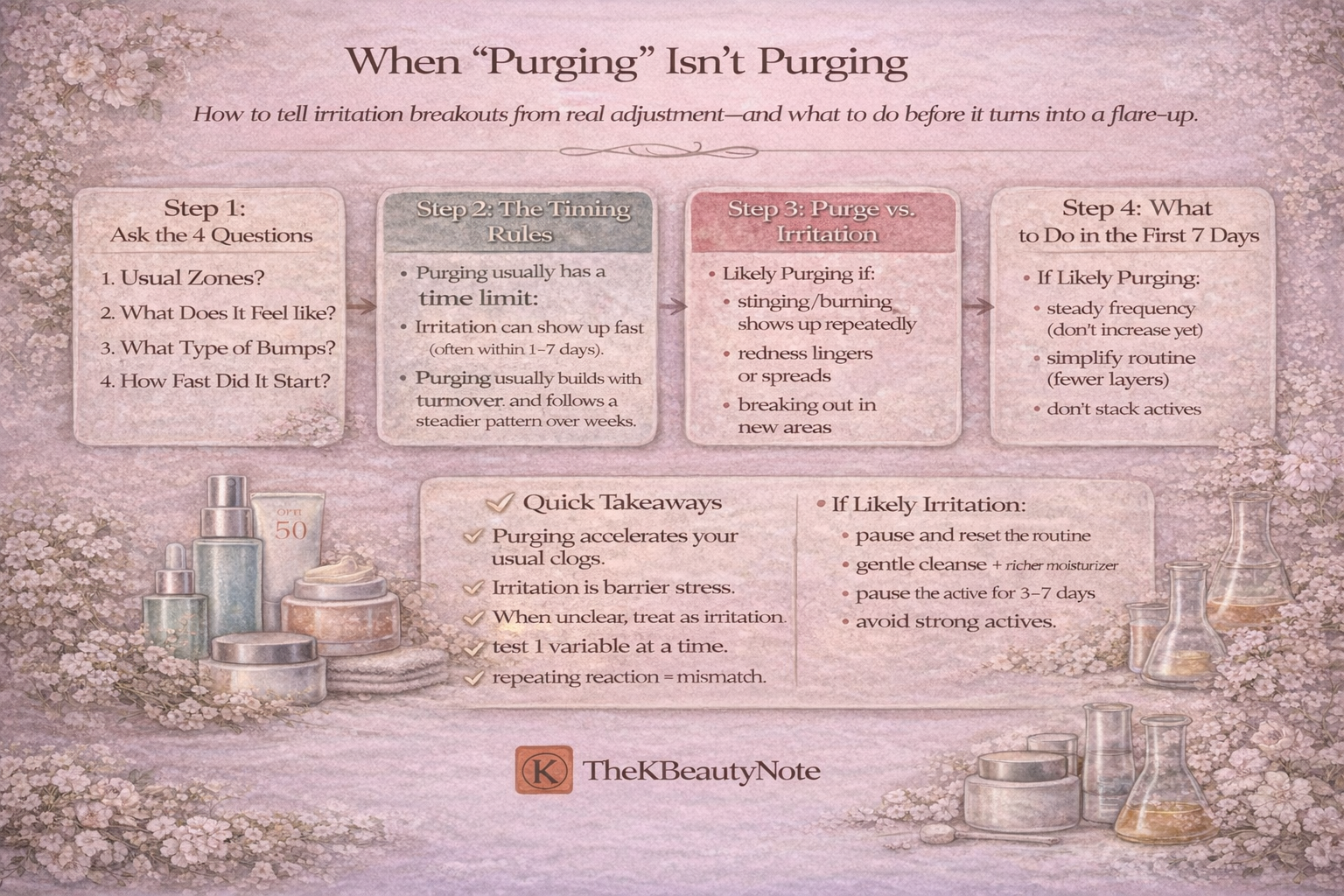
How to tell irritation breakouts from real adjustment—and what to do before it turns into a flare-up.
If you’ve ever started an active and suddenly broken out, you’ve heard this phrase:
“It’s just purging.”
Sometimes that’s true.
But sometimes it’s irritation, barrier stress, or a product that simply doesn’t agree with your skin.
And the problem is this:
If you mislabel irritation as “purging,” you keep pushing—
and the skin gets noisier: more redness, more stinging, more breakouts… until you stop everything.
This post is your clarity guide.
You’ll learn:
- what purging actually is (and what it isn’t)
- how to tell purging vs. irritation vs. congestion
- the fastest “decision rules” to stop guessing
- what to do in the first week if things start going wrong
- how to restart without repeating the cycle
First: what “purging” really means
Purging is an acceleration of what was already forming under the surface.
Actives that increase cell turnover (especially retinoids and exfoliants) can bring micro-comedones to the surface faster.
So purging is usually:
- temporary
- localized to your usual breakout zones
- similar to your typical acne pattern
- more about timing than severity
Purging is not a free pass for:
- burning
- stinging
- widespread redness
- new rash-like bumps
- sudden sensitivity to products you used yesterday
Those are barrier signals.
Before you decide: check your mode first
Before you decide it’s purging, check your mode: Stable vs. barrier-stressed.
If you’re already getting:
- repeated stinging
- persistent redness
- lingering tightness
- rough, sandpapery texture
…treat the situation as barrier stress first.
Actives are easiest when the skin is calm.
Step 1) Ask the 4 questions (the fastest way to classify it)
Question 1: Is it in your usual breakout zones?
Purging usually shows up where you already break out:
- chin, jaw, around mouth
- forehead for some people
- T-zone if you’re clog-prone
Irritation often spreads to places you don’t normally break out:
- sides of cheeks
- neck
- around the nose folds
- under eyes / sensitive edges
If it’s “new territory,” treat it as suspicious.
Question 2: What does it feel like?
This is a major divider.
Purging tends to feel like “acne.”
Irritation feels like “skin is angry.”
Red flags for irritation:
- stinging when you apply products
- burning after cleansing
- tightness that doesn’t fade
- itchiness
- heat + redness that lingers
If your skin feels reactive, your hydration system is being tested too hard.
Question 3: What type of bumps are they?
Purging tends to look like:
- small whiteheads
- inflamed pimples in normal zones
- short-lived clusters that resolve faster than usual
Irritation often looks like:
- lots of small uniform bumps (“rash-like”)
- inflamed patches + texture change
- sensitivity + breakouts together
- breakouts plus peeling in random areas
If everything looks the same and appears all at once, that’s rarely “cleaning out.”
That’s often inflammation.
Question 4: How fast did it start?
A helpful rule:
- Irritation can show up fast (often within 1–7 days)
- Purging usually builds with turnover and follows a steadier pattern over weeks
If you used it twice and suddenly you’re burning + breaking out everywhere, assume irritation.
Step 2) The timing rules (purging has a window)
Purging usually has a time limit.
For most people:
- it appears within the first 2–4 weeks
- it should plateau, then start improving within ~4–6 weeks
- it should not escalate week after week
If breakouts worsen beyond 6 weeks without any stabilization, it’s probably not purging.
The “too long” sign:
- every week is worse than the last
- sensitivity is rising
- your routine feels less tolerable, not more
That pattern is barrier stress.
Step 3) The “purge vs. irritation” decision tree
Use this simple classification:
Likely purging if:
- breakouts are in your usual zones
- bumps resemble your typical acne
- there’s little/no stinging or burning
- it plateaus and starts improving within 4–6 weeks
Likely irritation if:
- stinging/burning shows up repeatedly
- redness lingers or spreads
- you’re breaking out in new areas
- bumps look rash-like or uniform
- symptoms escalate day by day
If you’re unsure, treat it like irritation first.
You lose nothing by calming the barrier early.
You lose a lot by pushing through the wrong thing.
Step 4) What to do immediately (the first 7 days)
If it looks like purging (but your barrier is stable)
You don’t need to “push harder.”
You need to keep the system stable.
Do this:
- keep frequency steady (don’t increase yet)
- simplify the routine (fewer layers)
- keep barrier-support moisturizer stronger than usual
- avoid stacking high-load nights (retinoid + exfoliant)
Goal: hold steady until the skin adapts.
If it looks like irritation (or your barrier feels noisy)
Switch to the exit ramp immediately.
Pause the active for 3–7 days and run a mini reset:
- gentle cleanse (or rinse AM)
- barrier-support moisturizer AM + PM
- sunscreen
- optional occlusive spot-apply at night
If stinging is present, don’t negotiate with it.
Stinging is not “working.” It’s warning.
Step 5) A common trap: “It’s purging” + you keep adding things
People often stack:
- retinoid + exfoliant
- vitamin C + acid
- new moisturizer + new sunscreen
- extra “calming” serums
Then when the skin reacts, they can’t identify the cause.
Your best protection is still the same rule from earlier posts:
One change at a time. Hold it steady.
If you need to troubleshoot, you need clean variables.
Step 6) How to restart after irritation (without repeating it)
If you paused and your skin calmed down, restart like this:
- return to Stable Mode (no stinging, no persistent redness)
- restart one active only
- restart at lower frequency than before
- buffer if needed (moisturizer → active → moisturizer)
- hold steady for 2–4 weeks before changing anything
If the same reaction repeats twice, it’s not “adjustment.”
It’s a mismatch.
The “congestion” category (not purging, not irritation)
Sometimes it isn’t purging or irritation.
It’s simply:
- too heavy for your skin
- not layering well
- clogging your usual zones slowly
Clues for congestion:
- no burning/stinging
- bumps are slow, persistent, and mostly closed comedones
- texture feels thicker, not inflamed
- it doesn’t improve with time alone
In this case, the fix is often:
- adjust texture/format (lighter moisturizer, different sunscreen)
- reduce occlusive use
- simplify layers
- keep one driver active (don’t add more)
Start by changing texture/format first (before changing actives).
Congestion is about fit, not tolerance.
Quick takeaways
- Purging is acceleration of what was already forming—usually in your normal zones, with a limited window.
- Irritation is barrier stress: stinging, burning, spreading redness, rash-like bumps, escalating sensitivity.
- When unsure, treat it like irritation first. Calm the barrier before you push forward.
- Troubleshooting requires clean variables: one change at a time, steady testing.
- If it repeats, it’s not “adjustment.” It’s a mismatch.
Related posts in this Skin Functions series
- Skin Barrier & TEWL
- Hydration as a System
- Hydration Product Types: Humectants, Occlusives, and Barrier Support
- Hydration Routine by Season and Humidity
- Build a Hydration Routine That Matches Your Skin
- How to Introduce Actives Without Breaking Your Hydration System
- How to Choose Actives by Skin Goal (Without Increasing Barrier Load)
- How to Combine Actives Safely in Real Life
- How to Patch-Test and Troubleshoot Reactions
- How to Use Actives by Season and Lifestyle
- How to Use Actives by Skin Type (Without Changing the Active)
- How to Build an Active Calendar (A Simple 12-Week Plan)
- How to Choose Product Formats and Layer Them Correctly
- How to Build a Complete Routine by Skin Goal (Using Only 3–5 Products)
- K-Beauty Starter Kit vs Upgrade Kit
- How to Choose One “Hero” Product per Category
- How to Stop Routine Hopping
Next in Skin Functions
Next post: How to fix “plateau” without increasing irritation—when to adjust dose, frequency, or support (instead of switching products).